Authority stays with the operator
The operator and the local control layer retain defined authority to pause, override, isolate or revert the system at any time.

SIP-AI is documented as a closed-loop, operator-governed industrial control system.
This section holds the architecture, the equipment, the market
framework and the controls that sit around all of it.
Sensors and equipment-state data feed a local controller and a secure communications path. The analytics layer generates well-specific recommendations. A safety envelope, interlocks, permissions and operator controls constrain any command transmitted to the annular or tubing regulator. The resulting response returns to the data stream.
Gold marks the physical layer at the wellsite; blue marks the analytics and oversight layer.
The operator and the local control layer retain defined authority to pause, override, isolate or revert the system at any time.
A predictive model can estimate a preferred operating setting. A separate control policy verifies that the action falls within engineered constraints before anything moves.
The cybersecurity program defines which functions remain available when communications are lost, and what the safe local state is.
The two regulators are installed at the wellhead. Each has a back pressure valve, an actuator and a pressure sensor. The annular one carries a back-up valve because of high gas volatility. A small transmission box with a PLC and transmitter is connected to the two regulators by insulated wire.
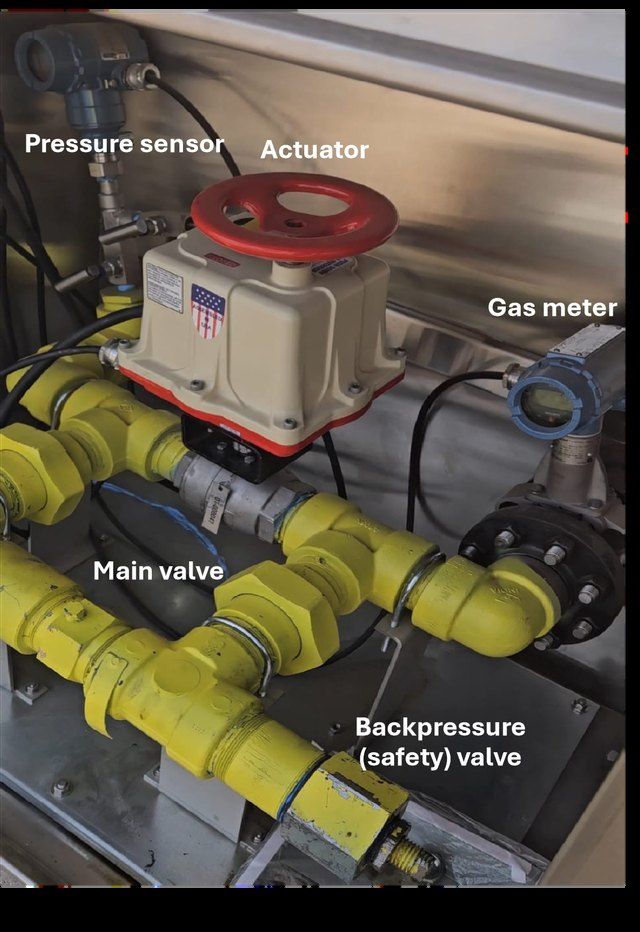 Regulator assembly · company source material
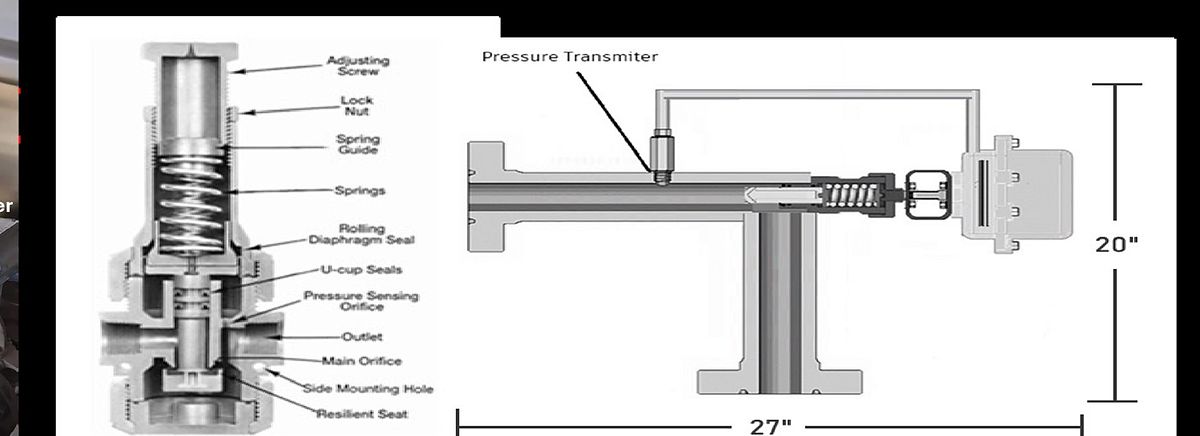 Valve section and dimensioned assembly
A pressure sandwich keeps the system stable and reduces pump gasification:
Sensors collect real-time pressure, temperature and gas-flow data, including fluctuations from eruptions, pump shutdowns, gas-lock issues and PID activations, all of which become quickly identifiable.
The annular valve begins pressurization under the control of the model, which dynamically adjusts the valve and retains the repetitive patterns and fluctuations in key well variables as it works to stabilize the well and the pump.
No optimization begins until the baseline, sensor quality, fail-safe response, operating envelope and responsible operator are approved.
SIP-AI is a predictive AI based on a multilayer feedforward neural network: information flows in one direction forward among its internal layers. This type of network is well suited to capturing and modelling the complex relationships among the many variables in oil production.
Real-time well data (pressure, temperature and gas flow rate), together with operator data, enters the network as the raw description of the well’s state.
The workhorse layers process the data with backpropagation algorithms that connect the neurons non-linearly, continually adjusting the weight of each connection according to how well the annular and tubing pressure settings improved gas performance.
The command layer receives the recommendations, translates them into commands and sends them to the annular and tubing valves, inside the safety envelope.
Where needed, the control room introduces its findings and corrected predictions as code in the hidden layer, creating a new neuron. The model is thus more deeply trained, covering even unforeseen circumstances.
SIP-AI builds on neural processes rather than simple automation with pre-set one-to-one input–output behaviour, and the algorithms are described as based on data collected on many hundreds of wells over more than fifteen years.
The operator is kept fully informed: daily data feeds from the sensors and valves and, if desired, a cloud room to monitor the system in operation.
Two reservoir cases, one mechanism
Venezuela combines a very large hydrocarbon resource base with a producing system that has experienced prolonged operational and investment constraints. A defensible market model begins from the wells themselves.
Million barrels per day. Both reported series, read together.
Sources: OPEC Annual Statistical Bulletin 2026 and OPEC Monthly Oil Market Report, August 2026. Reported values, not sustainable capacity and not forecasts. The IEA report of 12 August 2026 shows approximately 1.12 mb/d for July 2026.
OPEC’s 2026 Annual Statistical Bulletin reports 303.70 billion barrels of proved crude reserves at the end of 2025. The EIA’s country analysis describes most of that reserve base as extra-heavy Orinoco crude, and identifies underinvestment, poor maintenance, limited qualified personnel, diluent constraints, aging pipelines and weak refining infrastructure as material structural constraints.
Independent analysis similarly emphasizes brownfield rehabilitation, mature conventional wells, low-capex workovers, specialized services, electricity reliability, diluent, gathering, blending, storage and export logistics.
| Market layer | Formula | Required inputs |
|---|---|---|
| Total addressable market | Compatible producing wells × annualized revenue per well | Verified well universe by lift type, completion, production status and data availability; approved pricing |
| Serviceable available market | Total addressable wells × technical eligibility × legal and compliance eligibility × operational accessibility | Engineering screen, sanctions and counterparty screen, field access, connectivity and service capacity |
| Serviceable obtainable market | Serviceable wells × qualified pipeline conversion × annual deployment capacity | Named opportunities, sales cycle, installation crews, working capital, hardware supply, and churn or renewal |
The market includes global oilfield-service companies, artificial-lift equipment providers, production-automation suppliers, industrial software vendors and operator-built systems. The potential differentiation is the integrated combination of well-specific pressure-control practice, annular and tubing actuation, field implementation, operator workflow and verified economic outcomes.
| Dimension | Thesis | Diligence question |
|---|---|---|
| Physical intervention | Coordinated wellhead pressure control is part of the optimization method | Which competing valves, controllers, choke systems or wellhead-control packages provide similar functions? |
| Analytics | A well-specific model uses operating history and continuing feedback | What model class is used in production, what inputs are required, how is drift handled, and how does it outperform rule-based control? |
| Deployment | Installation without downhole intervention and, in some cases, without shutdown | What installation states are allowed, what barriers remain intact, and what operator approvals are required? |
| Evidence | Management reports strong production and pump-life outcomes | How many wells, operators, basins, lift types and comparable periods are represented, and what failed? |
| Operating service | Caracas control-room oversight | What service level, redundancy, staffing, connectivity, disaster recovery and audit process support scaled operations? |
| Defensibility | Proprietary algorithms and equipment configuration | What patents, trade secrets, data rights, customer restrictions and freedom-to-operate evidence exist? |
Published vendor outcomes are commercial case studies and are not automatically generalizable. They are used to understand the competitive proof standard, not to imply that SIP-AI will reproduce another vendor’s result.
The system affects pressure and therefore belongs inside the operator’s well-integrity and process-safety framework. The AI layer must not bypass safety instrumented functions or the operator’s approved control hierarchy.
The source materials state a perfect safety record to date; equipment manufactured in Texas meeting API and EC standards; pressure never exceeding 20% of casing tolerance; a dual back-up automatic cut-off system, electronic and pressure-actuated, with an additional manual cut-off lever at the wellhead; H2S sensors in the equipment and on personnel; and explosion-proof, Class I Division 1 certified equipment in a NEMA 4X enclosure.
Each statement requires a defined population, period, design calculation, test record, certificate and configuration match before it appears in external material. API Specification 6A is relevant to wellhead and tree equipment, but it does not certify the PLC application, the cloud, the AI model, gas detection or the complete installation. NEMA Type 4X describes enclosure performance; it is not by itself evidence of Class I, Division 1 approval.
Asset inventory, segmentation, secure remote access, least privilege, multi-factor authentication, key management, encrypted communications, tested updates, vulnerability management, logging, time synchronization, backups, recovery, incident response, supplier access and periodic assessment.
Validation, drift monitoring, versioning, human authority, rollback and auditability, with a defined statement of which functions remain available when communications are lost, and what the safe local state is.
Ownership of raw well data, derived features, models, alerts, reports, anonymized learnings and aggregated benchmarks is specified. Cross-customer use of operational data requires explicit contractual authorization and a documented de-identification standard.
Venezuela-related oil transactions require current, transaction-specific review. OFAC General Licenses 48C, 50C and 52B were issued on 27 August 2026, but each has defined parties, activities, exclusions, conditions and reporting implications. A proposed relationship cannot be assumed to qualify merely because a general licence exists.
OFAC’s 50 Percent Rule also requires aggregate blocked-ownership analysis, and BIS requires item-by-item classification and licence analysis. An OFAC authorization does not replace BIS or, where relevant, State Department authorization.
Nothing on this page is legal advice. Qualified counsel reviews each customer, supplier, investor, bank, shipment, cloud service and publication.
The source describes proprietary AI trained on data from hundreds of wells over more than fifteen years. That can be an important asset, but it only counts once the chain of title and the permissions behind it are documented.
| Protection layer | Required action |
|---|---|
| Patents | Map any issued, pending, abandoned or planned filings to specific hardware, control methods and claims; obtain freedom-to-operate analysis |
| Trade secrets | Identify protected algorithms, calibration methods, pressure-control practices, datasets and operating know-how; restrict and log access |
| Copyright | Confirm authorship and assignment for software, documentation, drawings, photographs and training materials |
| Data rights | Produce a customer-by-customer register of collection, use, retention, model-training, aggregation and publication rights |
| Open-source software | Maintain a software bill of materials, comply with licences, scan dependencies, and control contribution and release processes |
| Brand | Register and govern the Ecominas, SIP, SIP-3 and SIP-AI names and marks in priority jurisdictions |
Technical data sheets, control narratives and installation standards are shared under a diagnostic or pilot engagement, after a transaction-specific compliance review.